
How Long Until You Can Walk After Knee Replacement? Recovery Timeline & Medical Exercises

How long after knee replacement can I walk? is the top concern of most patients and families before entering surgery. With minimally invasive surgery techniques and modern early recovery protocols (ERAS), most patients can Practice standing and taking your first steps with a walker immediately after 12 - 24 hours. However, in order to walk steadily and return to normal activities, you will have to go through a step-by-week recovery path under the close supervision of a specialist..
| Stage | Timeline | Ability to Walk & Live | Support tools | Range of motion (ROM) |
|---|---|---|---|---|
| Boarding | The first 12 – 24 hours | Practice standing up from bed and taking a few short steps | Walker | Straighten 0°, flex ~60 - 70° |
| Weeks 1 – 3 | 7 – 21 days | Walk around the house, clean yourself, climb stairs with handrails | Frame or 2 crutches | Flexion reaches 90°, extension 0° |
| Week 4 – 6 | 1 – 1.5 months | Walk short distances outdoors, do light housework | 1 stick or no tools required | Flexion reaches 105° – 115° |
| Weeks 6 – 12 | 1.5 – 3 months | Walk comfortably, ride a stationary bike, drive (when your doctor allows it) | No tools required | Flexion reaches 115° – 120° |
| After 3 months | 3 – 12 months | Recover movement naturally, play light sports (swimming) | Independent movement | Knee joints are naturally flexible |
1. How long until you can walk after knee replacement? Reference recovery timeline
The recovery time after artificial knee replacement surgery (Total Knee Arthroplasty - TKA) is divided into 5 important milestones. Understanding the goals of each stage helps patients be more proactive and secure during the treatment process:
Milestone 1: First 24 hours after surgery (Inpatient phase)
In the past, traditional beliefs often held that after knee replacement surgery, one must lie immobile for 3 to 5 days. Currently, with the regimen ERAS (Enhanced Recovery After Surgery - Early recovery after surgery) Combining multimodal pain relief techniques (such as adductor canal anesthesia combined with PCA self-controlled pain relief), patients almost do not have to endure severe pain after surgery..
Only later 12 to 24 hours, When the anesthetic has worn off its main effect and the pulse and blood pressure are stable, the physical therapist will instruct the patient to practice muscle contractions in bed, sit up at the edge of the bed, stand up straight to bear weight, and take short steps around the hospital room with a walker..
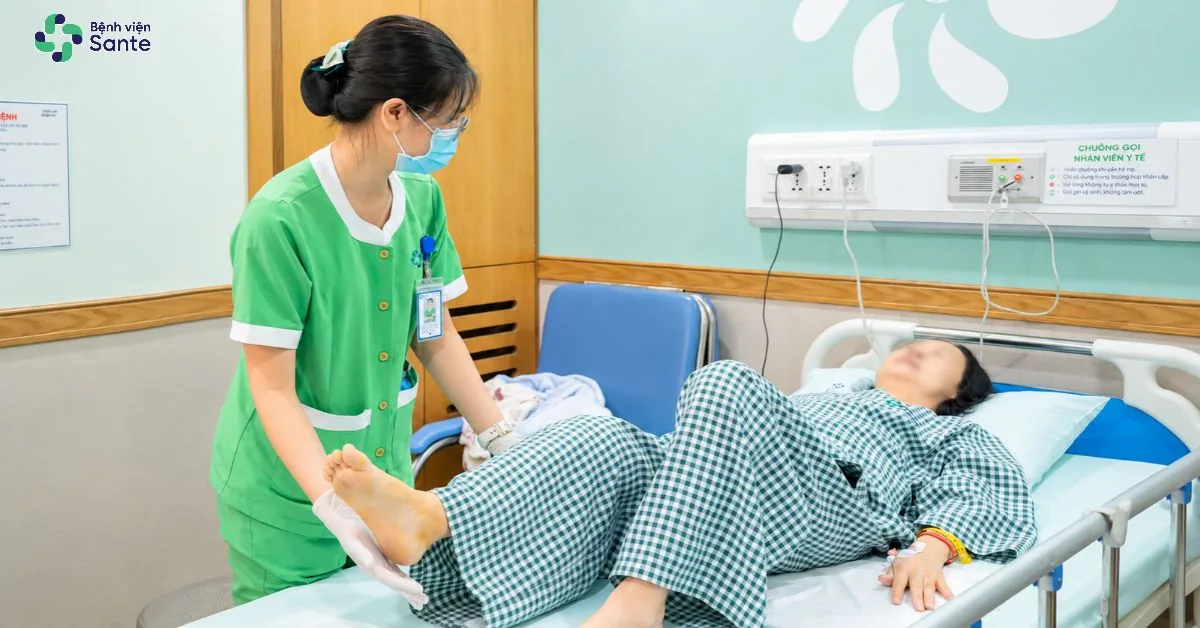
Actual video: The patient suddenly walked steadily after 24 hours of knee replacement at Sante International Hospital
Milestone 2: Weeks 1 to 3 (Beginning independent mobility)
Patients are usually discharged after 3-5 days of inpatient stay and continue their rehabilitation program at home:
- Travel: Move around the house with a walker or two crutches. The patient can walk around, do personal hygiene, and take a light bath (pay attention to keeping the incision dry as directed)..
- Stair: Start practicing walking up and down stairs under supervision: Step your healthy leg up before going up the stairs, and step down your surgical leg before going down the stairs.
- Range of motion: Aim for a minimum of 90 degrees of knee flexion and 0 degrees of full extension.
Milestone 3: Weeks 4 to 6 (Walking independently without assistive devices)
During this period, the strength of the thigh muscles (quadriceps) has improved significantly, and swelling has significantly reduced:
- Patients can switch from a walker to using a cane in the hand opposite the surgery side, or many patients can take short steps without needing an assistive device..
- Can cook for themselves, walk in the flat yard and participate in basic family activities.
Milestone 4: Weeks 6 to 12 (Advanced functional recovery)
Most of the soft tissue and bone around the artificial knee joint has healed:
- Patients can walk comfortably for 20 - 30 minutes without feeling tired.
- You can practice light resistance cycling on the spot to increase the flexibility of the joint capsule.
- If the doctor assesses that the patient has a safe braking reflex, the patient can consider driving again (usually after 6-8 weeks)..
Milestone 5: After 3 months to 1 year (Natural knee joint movement)
After 3 months, the patient enters the consolidation and maintenance phase. Artificial knee joints gradually become a natural part of the body. The process of micro tissue regeneration and strengthening of tendons and muscles continues to improve until 12 months after surgery, helping patients fully enjoy an active life, no longer tormented by joint pain..
2. Key factors determining recovery speed after knee replacement
Each patient has a unique recovery rate, depending on 5 main clinical factors:
- Precise surgical technique: The incision is minimally invasive, delicately exposed, and maximally preserves the musculature and ligaments around the knee, helping the wound to have less bruising and the patient to be able to walk sooner..
- Sterile operating room to control infection: Joint replacement surgery in a clean positive pressure operating room environment (ISO 6 / Class 1,000 standard) helps eliminate the risk of artificial joint infection - the most worrying complication that disrupts the walking process..
- Perseverance in practicing properly: Rehabilitation accounts for 50% of the success of surgery. Patients who follow the exercises and instructions of the specialist will walk faster and walk straighter.
- Underlying health condition: People in good physical condition, with a normal BMI and strong pre-operative thigh muscle mass will recover faster than debilitated or obese elderly people..
- Control swelling and reduce pain: Good control of pain and bruising in the first days helps patients walk confidently without being hindered by fear of pain..
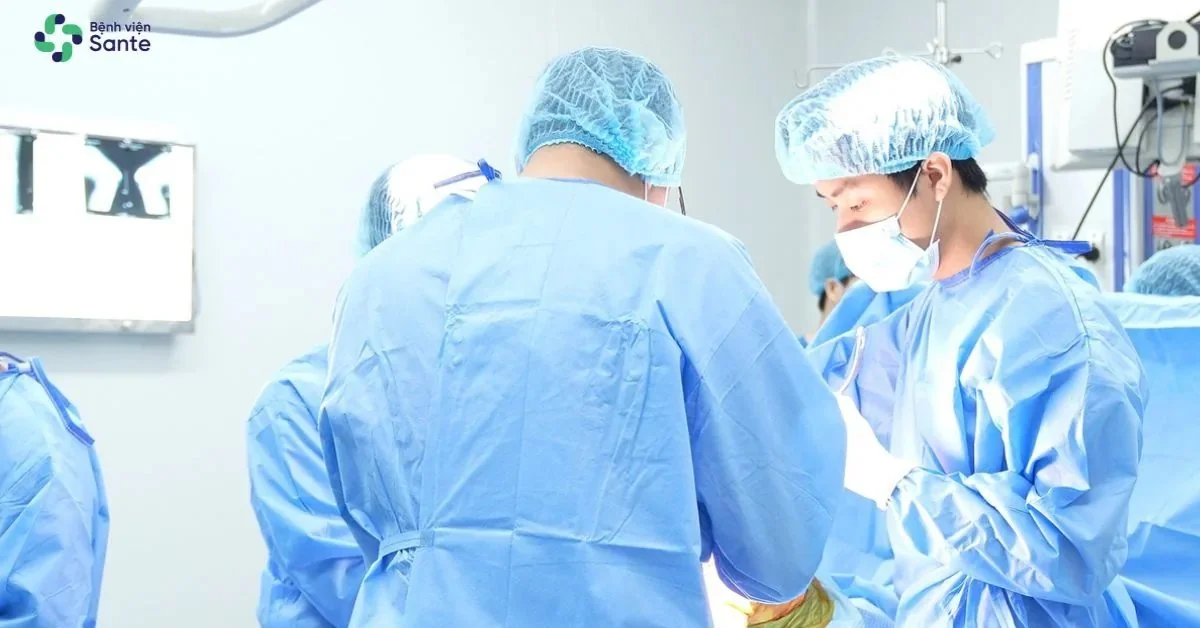
3. 4 simple rehabilitation exercises at home
Below are 4 basic exercises recommended by orthopedic experts to be performed daily (10 - 15 times each exercise, 2 - 3 times a day) to enhance thigh muscle strength and knee joint flexibility.:
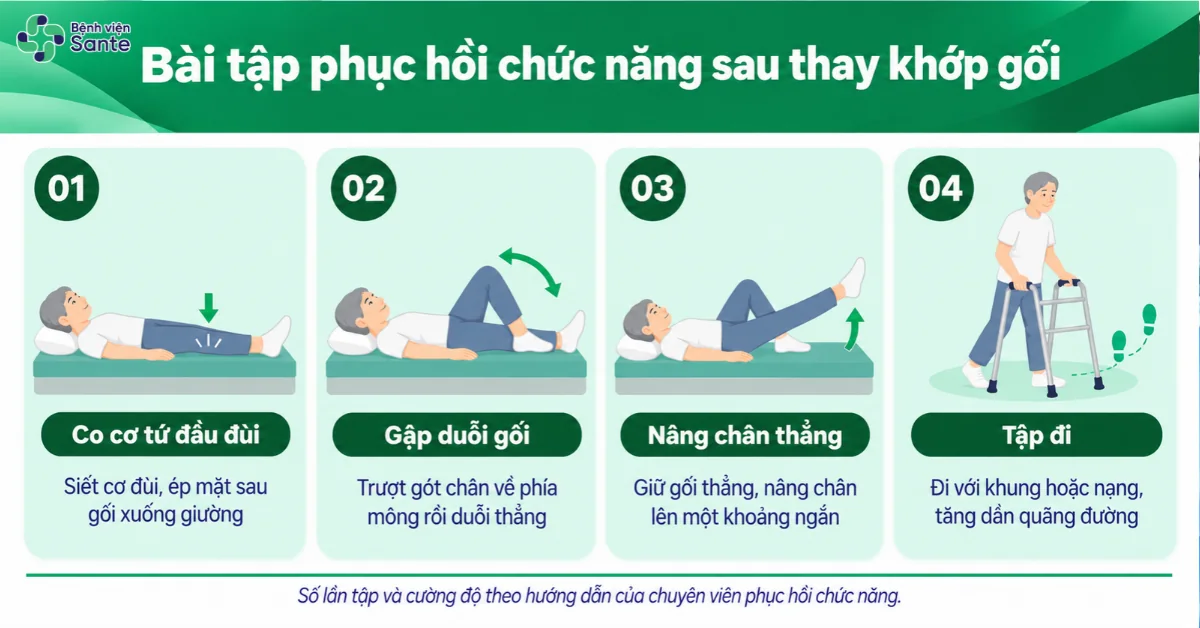
- 1. Quad Sets: Lie on your back or sit with your back straight and legs straight. Tighten your front thigh muscles, pressing the back of your knee close to the bed. Hold for 5 seconds, relax for 5 seconds, then repeat.
- 2. Active knee extension (Heel Slides): Lie on your back, gently slide your heels toward your buttocks to bend your knees to a moderate stretch angle, hold for 5 seconds and then slowly slide your legs straight back to the starting position..
- 3. Straight Leg Raises: Lie on your back, one leg bent, the operated leg straight. Tighten your thigh muscles, keep your knees absolutely straight, then lift your entire leg about 15 - 20cm above the bed, hold for 3 - 5 seconds, then lower slowly..
- 4. Practice walking with correct posture (Gait Training): Stand straight in the walker, step the surgical foot forward at the same time as the walker, then apply even force to the foot and step forward with the healthy foot to the same level. Avoid limping or slouching.
4. Guide to reducing pain and swelling and knee care after surgery
Swelling is the body's natural physiological response after joint replacement surgery. To help the knee joint relax and move more easily, patients need to take the following measures:

- Elevate your feet when resting: When lying or sitting, place pillows under your calves and heels so that your feet are higher than your heart level. Important note: Absolutely do not insert a pillow right under the kneecap because it will cause the knee to bend, preventing the practice of straightening the knee.
- Apply cold compresses properly: Use a gel pack or ice pack wrapped in a clean towel and apply it around the knee every 15 - 20 minutes, every 2 - 3 hours. Do not place ice directly on the skin to avoid frostbite.
- Take medication as prescribed: Full compliance with anti-inflammatory analgesics and especially prophylactic anticoagulants as prescribed by your doctor to prevent venous thromboembolism.
- Healthy nutrition: Supplement foods rich in protein (lean meat, fish, eggs), vitamin C and calcium to promote tissue and bone healing; Drink enough 1.5 - 2 liters of water every day.
5. Safe home preparation and fall prevention
Falling in the first weeks after surgery is a dangerous risk that can loosen or fracture around the artificial joint. Families need to proactively arrange a safe living space before welcoming the patient to discharge from the hospital:
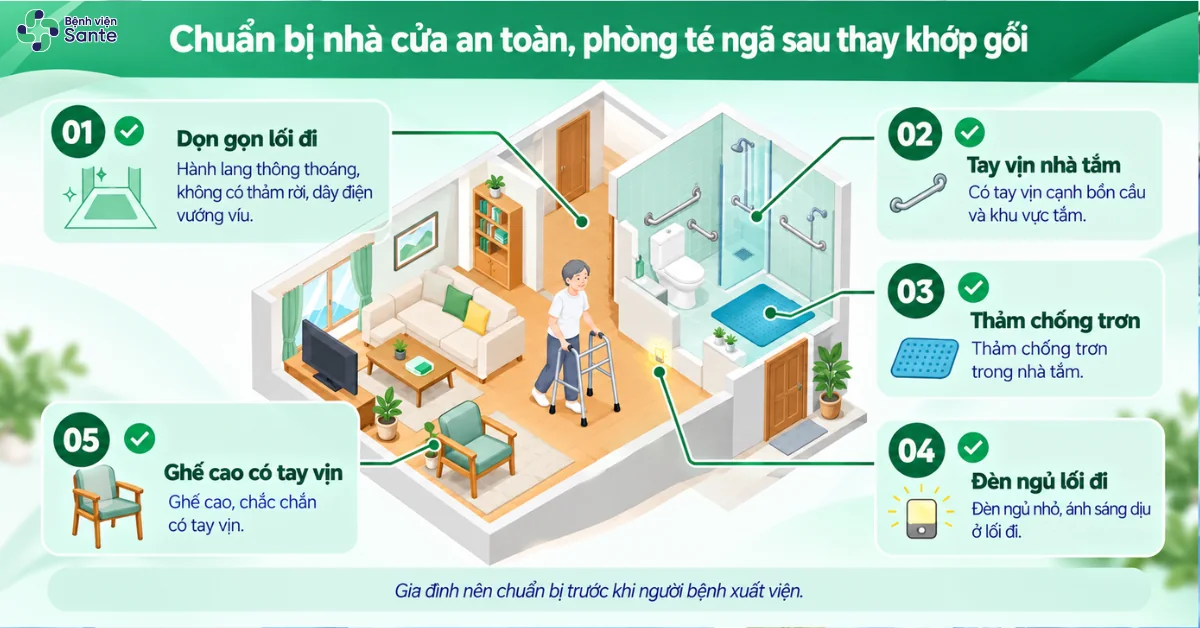
- Clear and clear walkways: Roll up loose rugs that are easy to slide, fold away electrical cords and other items that are stuck on the floor.
- Install bathroom handrails: Arrange sturdy handrails next to the toilet and shower area. Use a non-slip shower chair with a backrest so the patient can sit and bathe comfortably.
- Ensure lighting at night: Install night lights along the hallway from the bed to the bathroom so that the patient can clearly see their way when they wake up at night.
- Choose the right seat: Use a chair with firm cushions, armrests on both sides, and a moderate chair height (so that when sitting, your knees do not bend more than 90 degrees)..
6. Recommended and restricted activities after knee replacement
To ensure the lifespan of the artificial knee joint lasts 15 - 20 years or longer, patients need to master physical activity recommendations.:

- Activities should be given priority: Walk regularly on flat roads, swim gently (when the incision is completely dry), cycle on a low-resistance stationary bike, and practice gentle yoga and stretching..
- Activities that need to be strictly limited/avoided: Jogging, jumping rope, high-impact combat sports (soccer, basketball, high-intensity tennis), carrying objects weighing more than 10kg, deep squatting or kneeling with direct pressure on hard surfaces for long periods of time.
7. When should patients contact their doctor immediately?
During the process of learning to walk at home, if any of the following warning signs appear, the patient needs to contact a medical facility or go to the hospital to be examined immediately.:
- Signs of surgical wound infection: The surgical wound becomes increasingly red, hot, and swollen, with yellow or foul-smelling pus discharge, accompanied by a high fever above 38°C or chills..
- Signs of deep vein thrombosis (DVT): The calf of the operated side (or the healthy side) is tight, suddenly swollen, and the pain increases when the foot is bent upward..
- Signs of pulmonary embolism (Urgent emergency): Sudden difficulty breathing, shortness of breath, chest pain or coughing up blood.
- Sudden severe pain: After a trip or fall or hearing a cracking sound at the knee joint and no longer being able to stand and lean on the leg to bear the weight.
8. Frequently asked questions after knee replacement surgery (FAQ)
1. How long after knee replacement can I walk normally without crutches?
Most patients can completely abandon their walker or crutches 4 to 6 weeks When thigh muscle strength has recovered steadily and gait is balanced. However, the time to remove the device needs to be directly evaluated by a rehabilitation specialist or doctor to avoid limping..
2. Can I climb stairs after knee replacement?
Yes. Patients are often instructed to practice climbing stairs with handrails from the 2nd or 3rd week after surgery. Safety rules to remember: Up with the healthy leg - Down with the operated leg (The healthy leg steps up before climbing up, the operated leg steps down before going down).
3. How long will it take for the patient to be able to drive?
If surgery is on the left leg and driving an automatic vehicle, the patient can drive after about 2 - 4 weeks when no longer using sedative pain medication. If the surgery is on the right leg (accelerator and brake pedal), the patient needs to wait for a while 6 to 8 weeks so that the muscles can recover enough to have a safe emergency braking reflex.
4. After knee replacement, can I squat or kneel?
Doctors recommend Do not squat deeply or kneel for long periods of time. Although modern artificial knee joints allow high flexion ranges, squatting or pressing the knee directly on a hard floor will increase pressure on the polyethylene cushion surface, speeding up wear and reducing the life of the joint..
5. Does the artificial knee joint make a clicking sound when walking?
A slight clicking sound or mechanical sensation when bending and extending the knee is a fairly common phenomenon due to the metal surface contacting the medical plastic cushion. If the cry is not accompanied by severe pain or swelling, heat and redness, it is completely normal and nothing to worry about.
6. How many years can an artificial knee joint be used?
With high-quality biomedical alloy materials and modern ultra-high molecular weight polyethylene cushions, above 90 - 95% of artificial knee joints have a lifespan of 15 to 20 years or even longer if the person maintains a healthy weight and avoids strong contact sports.
Medical References
- American Academy of Orthopaedic Surgeons (AAOS). Activities After Knee Replacement & Total Knee Replacement Recovery Guide.
- National Health Service (NHS UK). Knee replacement surgery: Recovery and rehabilitation.
- Wainwright TW, et al. (2020). Consensus statement for perioperative care in total hip replacement and total knee replacement surgery: Enhanced Recovery After Surgery (ERAS®) Society recommendations. Acta Orthopaedica, 91(1):3-19.
- Ministry of Health of Vietnam (2014). Guide to diagnosis and treatment of musculoskeletal diseases, issued together with Decision No. 361/QD-BYT.
Rehabilitation Consultation & Knee Examination at SANTE
Sante International Hospital's team of orthopedic doctors and physiotherapists always accompany you on every step of your safe and steady recovery..